


The Cool Connection: Exploring Earth-to-Water Heat Exchange Technology
Discover how an earth to water heat exchanger provides efficient heating & cooling. Learn about geothermal benefits & installation.


Why Understanding Earth-to-Water Heat Exchange Matters for Your Home
An earth to water heat exchanger is the core technology in geothermal heating and cooling systems that transfers heat between your home and the stable temperature underground. Here's what you need to know:
- In Winter: The system absorbs heat stored in the ground (which stays around 45-55°F year-round) and transfers it into your home through a water-based loop and heat pump
- In Summer: The process reverses—heat is pulled from your home and transferred back into the cooler earth
- Key Components: Underground pipes (ground loop), a heat pump unit, and a distribution system work together to provide year-round comfort
- Energy Efficiency: These systems achieve 400-600% efficiency because they move heat rather than generate it, using significantly less energy than traditional furnaces or air conditioners
If you're a Central Missouri homeowner tired of unpredictable energy bills and dealing with aging HVAC equipment, earth-to-water heat exchange technology offers a proven path to reliable, efficient comfort. Unlike conventional systems that fight against outdoor temperature extremes—sweltering summers and frigid winters—geothermal systems tap into the earth's consistent underground temperature as a stable energy source. This means your heating and cooling performance stays steady regardless of what's happening above ground, and you'll use far less energy in the process.
For more information on how geothermal systems can transform your home comfort, explore our geothermal heat pump services, or contact our team to schedule a consultation and see if this technology is right for your property.
The beauty of this technology lies in its simplicity: the ground just a few feet below the surface maintains a remarkably stable temperature throughout the year. While air temperatures in Missouri can swing from below zero in January to over 100°F in July, the earth stays around 50-55°F at depths of just 10-20 feet. An earth-to-water heat exchanger leverages this natural thermal stability, circulating a water-based solution through underground pipes to absorb or reject heat as needed.
How Geothermal Systems Harness Earth's Stable Temperature
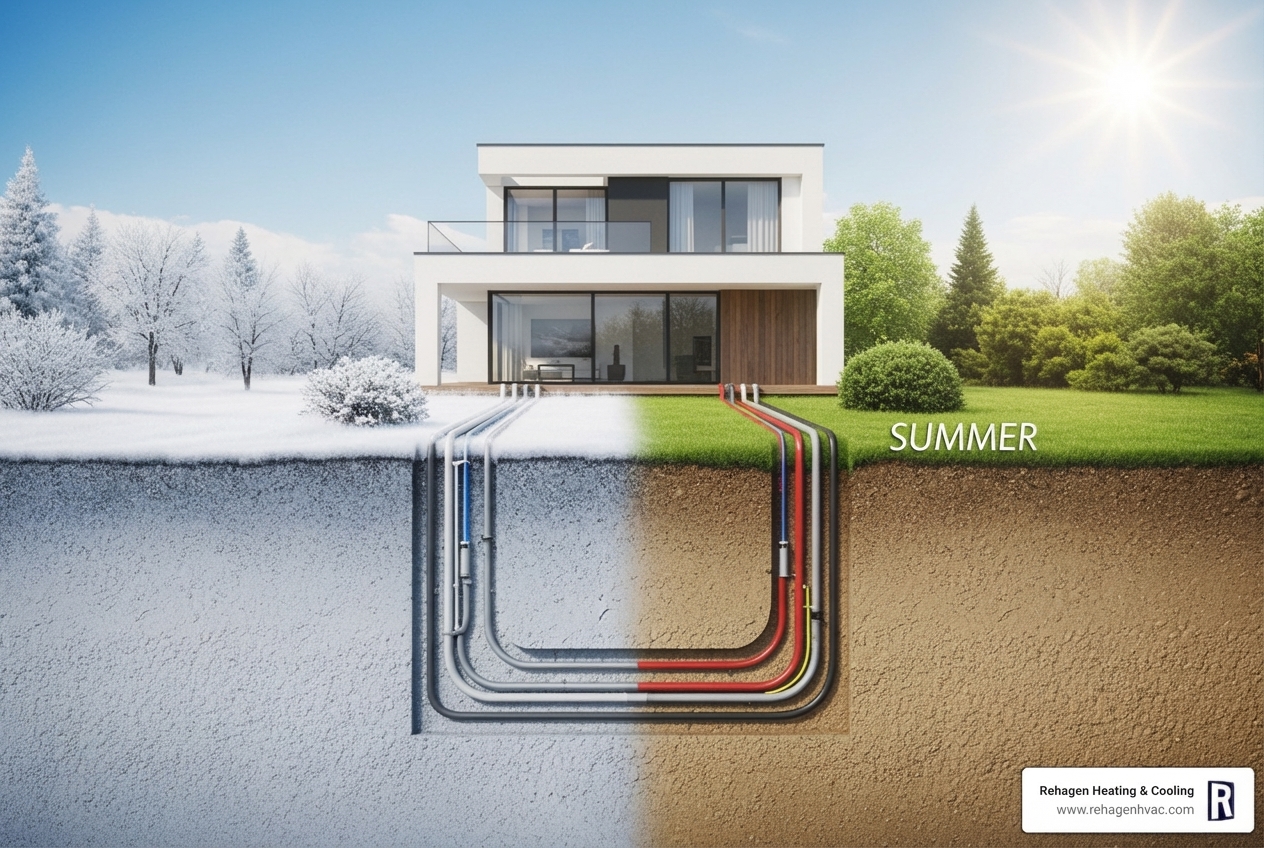
Imagine the earth beneath your feet as a giant, natural thermal battery. This isn't just a poetic notion; it's the fundamental principle behind how an earth to water heat exchanger works. A few feet below the surface, the ground acts as a consistent heat reservoir. In the summer, when the air above is scorching, the earth remains cooler, making it an ideal "heat sink" to absorb excess heat from your home. Conversely, in the winter, when the outside air is frigid, the earth retains warmth, serving as a constant "heat source" to draw from.
This remarkable stability is due to the thermal mass of the ground, which effectively insulates deeper layers from the drastic temperature swings experienced at the surface. While the top meter or so of soil might fluctuate with daily and seasonal weather, just 10-20 feet down, the temperature consistently hovers between 45-55°F year-round, regardless of how extreme the weather gets in Central Missouri. This consistent underground temperature is the geothermal system's secret weapon, providing a reliable and efficient medium for heat exchange.
The science behind this is straightforward: heat naturally flows from warmer areas to cooler areas. Geothermal systems capitalize on this by circulating a heat-transfer fluid through a buried network of pipes, known as the ground loop. In heating mode, the fluid absorbs the earth's relatively warmer temperature. In cooling mode, the fluid releases heat into the earth's relatively cooler temperature. This constant exchange means our systems don't have to generate heat or cold from scratch, but rather move existing thermal energy, leading to incredible efficiencies.
How an Earth to Water Heat Exchanger Powers Heating and Cooling
Let's explore the fascinating mechanics of how an earth to water heat exchanger provides year-round comfort:
Winter Heating Cycle:When winter's chill descends upon Central Missouri, our geothermal system springs into action. A water-based solution, often mixed with a non-toxic antifreeze, circulates through the underground pipes of the ground loop. As this fluid flows through the earth, it absorbs the natural heat stored in the ground. Even if the outside air is below freezing, the ground at depth maintains a steady temperature of 45-55°F.
This now-warmed fluid returns to the indoor heat pump unit. Inside the heat pump, a refrigerant absorbs this heat from the fluid. The refrigerant is then compressed, which significantly increases its temperature. This superheated refrigerant then transfers its warmth to the air distribution system of your home. Warm, comfortable air is then circulated through your ducts, keeping your living spaces cozy without the need for fossil fuels or battling freezing outdoor air. This process is far more efficient than traditional furnaces or air-source heat pumps trying to extract warmth from frigid air.
Summer Cooling Cycle:When the scorching summer heat and humidity hit, the geothermal system simply reverses its operation to provide efficient cooling and dehumidification. Hot air from your home is drawn into the indoor heat pump unit. Here, a refrigerant absorbs the heat from your indoor air. This heated refrigerant then transfers its warmth to the water-based solution circulating in the ground loop.
The now-hot fluid travels back into the cooler earth through the underground pipes. As it flows, it releases the absorbed heat into the ground, which acts as our efficient heat sink. The cooled fluid then returns to the heat pump, ready to absorb more heat from your home. Simultaneously, as the air passes over the cool coils in the heat pump, moisture is removed, providing excellent dehumidification alongside comfortable cooling. This cycle effectively moves unwanted heat from your home and deposits it into the stable, cooler earth, ensuring your home remains a refreshing oasis.
Key Components of an Earth to Water Heat Exchanger System
Understanding the core components of a geothermal system helps us appreciate its ingenuity and efficiency. While the concept might seem complex, the system is neatly designed to work seamlessly.
At its heart, every geothermal system consists of three main parts: the underground piping (the ground loop), the indoor heat pump unit, and the distribution system that delivers conditioned air or water throughout your home. Together, these elements form a highly efficient, reliable, and environmentally friendly heating and cooling solution.
The Ground Loop: The Core of the Earth to Water Heat Exchanger
The ground loop is arguably the most critical component, as it's where the magic of the earth to water heat exchanger truly happens. This network of buried pipes is what facilitates the transfer of thermal energy between your home and the earth.
These pipes are typically made of high-density polyethylene (HDPE), a durable and flexible plastic that can withstand underground conditions for decades. Inside these pipes, a water-based solution, often mixed with a small amount of non-toxic, biodegradable antifreeze (like propylene glycol), circulates continuously. This mixture is our "heat transfer fluid," responsible for carrying thermal energy.
There are two primary types of ground loop systems:
- Closed-Loop System: This is the most common type for residential applications. The heat transfer fluid circulates in a sealed, continuous loop of pipes buried underground. It constantly exchanges heat with the earth without ever coming into direct contact with the soil or groundwater. This ensures the system remains clean and protected, minimizing environmental impact.
- Open-Loop System: Less common, this system uses an existing water well. It draws groundwater, passes it through the heat pump's heat exchanger to extract or reject heat, and then discharges the water back into a separate injection well or a suitable surface water body. While highly efficient, open-loop systems require a sufficient supply of clean groundwater and adherence to specific local regulations regarding water use and discharge.
The Heat Pump and Distribution System
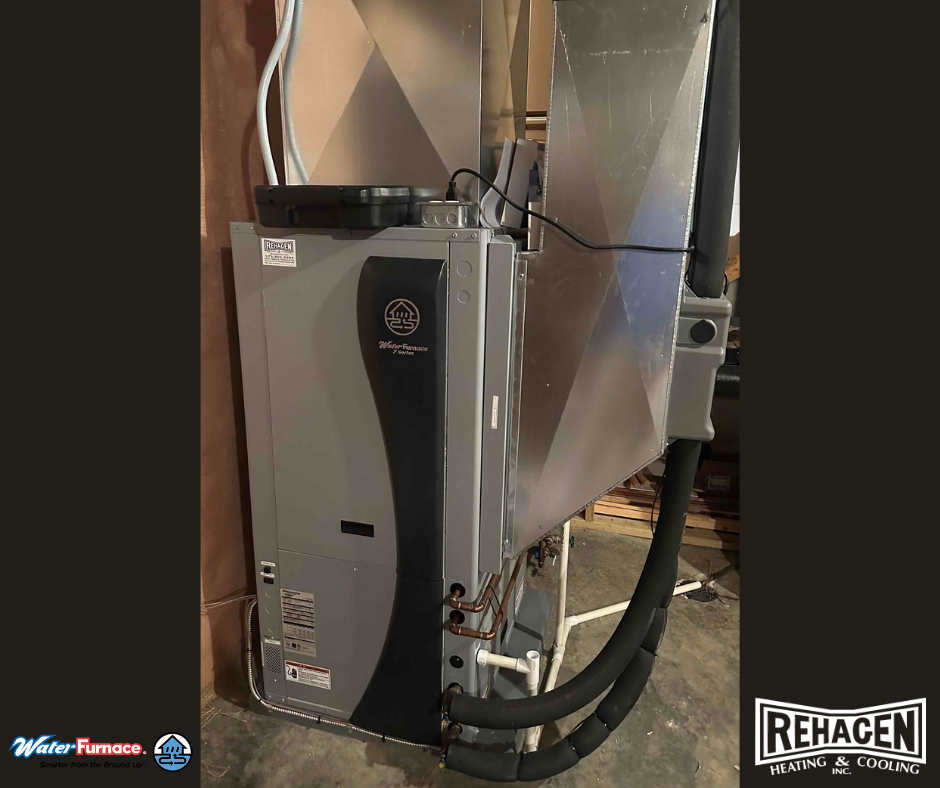
Once the heat transfer fluid has absorbed heat from the earth (in winter) or from your home (in summer), it travels to the indoor geothermal heat pump unit. This unit is essentially an intelligent appliance that uses a refrigeration cycle to concentrate or dissipate the thermal energy. It contains a compressor, a fan, and a refrigerant loop, all working in harmony to transform the earth's stable temperature into comfortable indoor conditions.
Geothermal systems come in various configurations to suit different home needs:
- All-in-One Systems: These compact units handle both heating and cooling, often distributing conditioned air through existing ductwork, similar to a traditional furnace and air conditioner setup.
- Split Systems: These offer more installation flexibility. The indoor heat pump unit can be paired with a separate air handler for forced-air distribution or integrated with existing hydronic (water-based) systems.
- Hydronic Systems: Designed specifically for heating or cooling water, these units are perfect for applications like radiant floor heating, domestic hot water production, and even snow/ice melt systems. They can also replace traditional boilers.
- Combo Units: Combining the best of both worlds, these units can provide both forced-air heating and cooling as well as hydronic heating, offering versatile comfort solutions.
Whether it's forced-air distribution through ducts or luxurious radiant floor heating, the geothermal heat pump ensures that the earth's energy is efficiently delivered throughout your Central Missouri home.
Types of Geothermal Ground Loop Configurations
Choosing the right ground loop configuration is a critical step in designing an optimal geothermal system for your Central Missouri property. Our experienced team conducts a thorough site evaluation, considering factors like available property size, soil composition, and local geology. This assessment helps us determine the most effective and efficient type of earth to water heat exchanger for your unique needs.
Closed-Loop Systems
Closed-loop systems are the most common and versatile type of ground loop, especially suitable for residential applications. They involve a sealed network of pipes, typically made of durable HDPE, circulating a water and antifreeze solution. This solution continuously exchanges heat with the earth without ever coming into direct contact with the surrounding environment.
Here are the main types of closed-loop configurations:
- Vertical Loops: Ideal for properties with limited yard space, vertical loops involve drilling several boreholes, usually 150-400 feet deep, into the ground. U-shaped HDPE pipes are inserted into these boreholes, and the boreholes are then filled with a thermally conductive grout to ensure efficient heat transfer. This configuration requires minimal surface area, making it a popular choice in developed areas.
- Horizontal Loops: If you have ample land, horizontal loops might be a more cost-effective option. These involve excavating trenches (typically 3-8 feet deep, below the frost line) where long sections of HDPE pipe are laid either as single pipes or in multiple parallel runs. While requiring more land, the excavation is generally less complex than drilling.
- Pond/Lake Loops: For homes near a suitable body of water (pond, lake, or even a river in some cases), a pond loop can be a highly efficient choice. Coils of HDPE pipe are submerged at sufficient depth to ensure stable temperatures and are anchored to the bottom. This method requires careful consideration of water quality, depth, and local regulations. The FRANK WET system mentioned in our research, for instance, is an example of a water heat exchanger designed for lakes and rivers, using a closed circuit for safe operation.
- Slinky Loops: A variation of the horizontal loop, slinky loops involve coiling the HDPE pipe into a "slinky" shape before burying it in trenches. This allows more pipe to be laid in a shorter trench length, reducing the overall excavation footprint compared to straight horizontal runs, while still being more shallow than vertical bores.
The flexibility in these closed-loop configurations allows us to design a system that perfectly fits your property's characteristics, ensuring optimal performance and minimal disruption to your landscape.
Open-Loop Systems
Open-loop systems, also known as groundwater heat pump systems, directly use groundwater as the heat transfer fluid. These systems are highly efficient but depend on having an accessible and abundant groundwater source, as well as specific geological conditions.
The process involves:
- Supply Well: Water is drawn from a supply well, which must be capable of providing the required flow rate for the system's heating or cooling capacity.
- Heat Exchanger: The groundwater is then pumped through the geothermal heat pump's heat exchanger, where thermal energy is extracted (for heating) or rejected (for cooling).
- Discharge Well: After passing through the heat pump, the water is returned to the aquifer via a separate injection or discharge well. It's crucial that the supply and injection wells are completed in the same aquifer to avoid mixing waters of different chemistries.
For homeowners in Central Missouri considering an open-loop system, careful attention to water quality is paramount. Factors like mineral content and corrosiveness can affect system longevity. Moreover, local regulations and permits are typically required for groundwater usage and discharge, often involving agencies like the Department of Natural Resources for water appropriation permits if usage exceeds certain thresholds (e.g., over 10,000 gallons per day or 1 million gallons per year, as seen in some state regulations). Our team can help steer these requirements to ensure a compliant and effective installation.
The Unseen Advantages of Geothermal Technology
Beyond the impressive engineering, the true beauty of geothermal technology lies in the profound advantages it offers to homeowners and the environment. When you install an earth to water heat exchanger system, you're not just upgrading your HVAC; you're investing in a smarter, more sustainable future for your home.
Lifespan and Reliability
One of the most compelling benefits of geothermal systems is their exceptional lifespan and robust reliability. Unlike traditional HVAC units that sit exposed to the elements, the most durable part of your geothermal system—the ground loop—is buried safely underground. This protection from weather, vandalism, and accidental damage means the ground loop system can last an astonishing 50 years or more! We're talking about a system component that could outlast your mortgage and potentially your home itself.
The indoor heat pump unit, while having a shorter lifespan than the ground loop, is still incredibly durable. Because it's housed indoors, away from harsh outdoor conditions, it typically lasts for more than 20 years. This longevity significantly reduces the frequency and cost of equipment replacement compared to conventional systems, which often need replacing every 10-15 years.
This impressive durability, combined with minimal moving parts exposed to the elements, translates directly into minimal maintenance requirements. Our systems are designed for long-term, trouble-free operation, providing reliable comfort year after year.
Efficiency Compared to Conventional HVAC
Prepare to be amazed by the efficiency of geothermal systems. While a high-efficiency gas furnace might boast 98% efficiency, geothermal systems achieve an incredible 400-600% efficiency! This isn't a typo; it means that for every unit of electricity used to power the system, it delivers 4 to 6 units of heating or cooling energy. This is measured by metrics like the Coefficient of Performance (COP) for heating and the Energy Efficiency Ratio (EER) for cooling, with residential units typically having COPs ranging from 2.4 to 5.0 and EERs from 10.6 to 30.
How do they achieve this? By simply moving heat rather than burning fuel or generating cold air. This makes them:
- More Efficient than Air-Source Heat Pumps: Air-source heat pumps struggle in extreme Central Missouri temperatures, working harder and consuming more energy as the outdoor air gets colder or hotter. Geothermal systems, however, always draw from the stable 45-55°F earth, providing consistent performance regardless of the outside air. They are also significantly quieter, as the noisy condenser unit is eliminated outdoors.
- More Efficient than Furnaces: Geothermal heating is far more efficient than oil, natural gas, or propane furnaces, drastically cutting your heating costs.
- Superior in Extreme Weather: While conventional systems lose efficiency when they're needed most (on the coldest winter days or hottest summer days), geothermal systems maintain their high efficiency because the ground temperature remains constant. This means consistent comfort and stable energy bills, even during temperature extremes.
This unparalleled efficiency translates directly into lower energy consumption—and corresponding air pollution emissions—up to 72% compared to electric resistance heating with standard air-conditioning equipment. This also means significant savings on your utility bills, potentially cutting your heating, cooling, and hot water costs by up to 70%. Over 20 years, homeowners could save between $30,000 and $70,000 by choosing geothermal.
Installation and Maintenance Considerations
Installing an earth to water heat exchanger system is a significant investment, and it's one we take seriously. Unlike simply swapping out a furnace, geothermal installation requires specialized knowledge and equipment.
The process begins with a comprehensive site assessment, where our NATE-certified professionals evaluate your property's specific characteristics, including soil type, available land, and geological conditions. This information is crucial for designing the most efficient ground loop configuration for your Central Missouri home. For vertical loops, drilling and excavation will be necessary, which we handle with precision and care. Once the ground loop is installed and connected to the indoor heat pump unit, the entire system undergoes thorough commissioning to ensure optimal performance.
Typical Maintenance Requirements
One of the often-overlooked advantages of geothermal systems is their remarkably low maintenance requirements. Because the ground loop is buried and the heat pump unit is indoors, these systems are protected from the wear and tear that outdoor units face.
Typical maintenance for a geothermal system is minimal and often involves:
- Indoor Unit Checks: Regularly inspecting the indoor heat pump unit for any unusual noises or performance issues.
- Air Filter Replacement: Just like any forced-air system, regular replacement of air filters is essential to maintain good indoor air quality and system efficiency.
- Loop Pressure Monitoring: Periodically checking the pressure in the ground loop to ensure the heat transfer fluid is circulating correctly.
- Professional Annual Inspection: We recommend an annual professional inspection to ensure all components are functioning optimally, catch any potential issues early, and keep your system running at peak efficiency for decades to come. This proactive approach helps protect your investment and ensures long-term reliability.
Permits and Regulations
Installing an earth to water heat exchanger system, especially one involving ground loops or groundwater usage, typically requires navigating local regulations and obtaining specific permits. These requirements are in place to ensure environmental protection, proper installation practices, and public safety.
For Central Missouri homeowners, this usually means:
- Local Building Codes: Compliance with local building codes is always necessary for any major home renovation or HVAC installation.
- Environmental Regulations: Depending on the type of ground loop (especially open-loop systems), environmental regulations might come into play. These can govern groundwater usage, discharge, and the types of heat transfer fluids permitted. For instance, some state regulations specify that heat transfer fluids must be propylene glycol or ethanol meeting certain safety standards to minimize potential groundwater contamination.
- Well Permits: If you're considering an open-loop system that uses groundwater, you'll need specific well permits for both the supply and injection wells. These permits often ensure that the system doesn't deplete local aquifers or adversely affect water quality.
- Utility Coordination: Coordination with local utilities might be necessary for electrical connections and to ensure your system integrates smoothly with the existing infrastructure.
Our team at Rehagen Heating & Cooling is well-versed in the local permitting processes for Central Missouri. We'll guide you through the necessary steps, ensuring your geothermal installation is fully compliant with all applicable regulations, so you can enjoy your new system with complete peace of mind.
Frequently Asked Questions about Earth-to-Water Heat Exchangers
We understand you might have questions about embracing this innovative technology. Here are answers to some of the most common inquiries we receive about earth to water heat exchanger systems:
How effective are geothermal systems in climates with extreme winters?
Geothermal systems are incredibly effective, even in Central Missouri's most extreme winters! The key lies in the earth's stable underground temperature. While the air above ground can plummet to frigid lows, the ground just a few feet beneath the surface consistently maintains a temperature between 45-55°F. Your geothermal system doesn't rely on the variable, freezing outdoor air; instead, it draws heat from this constant, warmer underground reservoir. This means it provides consistent, efficient heating without having to "work harder" or lose efficiency as the outside temperature drops, ensuring your home stays comfortably warm all winter long.
Is the fluid in the underground pipes harmful to the environment?
For modern closed-loop geothermal systems, the fluid circulating in the underground pipes is typically a non-toxic, biodegradable solution of water mixed with propylene glycol or ethanol. These fluids are specifically chosen for their low environmental impact. In the extremely rare event of a leak, they are designed to be safe for the surrounding soil and groundwater. Open-loop systems, which use actual groundwater, simply return the water to the aquifer after heat exchange, with only a minor temperature change. Rest assured, environmental safety is a top priority in the design and operation of all our geothermal installations.
How much space is needed to install a geothermal system?
The amount of space required depends primarily on the type of ground loop chosen, and we'll help you determine the best fit for your property during our site assessment.
- Vertical Loops: These are ideal for properties with limited yard space, as they require very little surface area. Boreholes are drilled vertically, often in a compact footprint, making them suitable for smaller lots or even existing landscapes.
- Horizontal Loops: If you have more available land, horizontal loops might be an option. These involve excavating trenches (typically 3-8 feet deep) where pipes are laid horizontally. This requires more linear footage of land but generally avoids deep drilling.
Our expert team will evaluate your property in Central Missouri to design a system that maximizes efficiency while minimizing disruption to your yard and landscape.
Experience the Future of Comfort
The future of home comfort is here, and it's powered by the earth beneath your feet. Geothermal technology, with its advanced earth to water heat exchanger systems, offers unparalleled energy efficiency, long-term reliability, and sustainable comfort for your Central Missouri home. By tapping into the stable temperatures of the earth, you gain energy independence, reduce your carbon footprint, and enjoy consistent, quiet heating and cooling year-round.
At Rehagen Heating & Cooling, we're proud to be Central Missouri's experts in geothermal solutions. With over 40 years of experience, we provide honest service, precision workmanship, and reliable comfort, backed by strong warranties and NATE-certified professionals. We're dedicated to helping you find the lasting benefits of geothermal.
Ready to explore how geothermal can transform your home? Learn more about geothermal heat pumps and let us help you connect with the earth's natural energy.
Related articles

request service
