


Sun, Earth, and Savings: Your Guide to Geothermal Solar Hybrid Systems
Maximize savings and energy independence with a geothermal solar hybrid system. Learn how sun and earth team up.


Why Homeowners Are Turning to Geothermal Solar Hybrid Systems
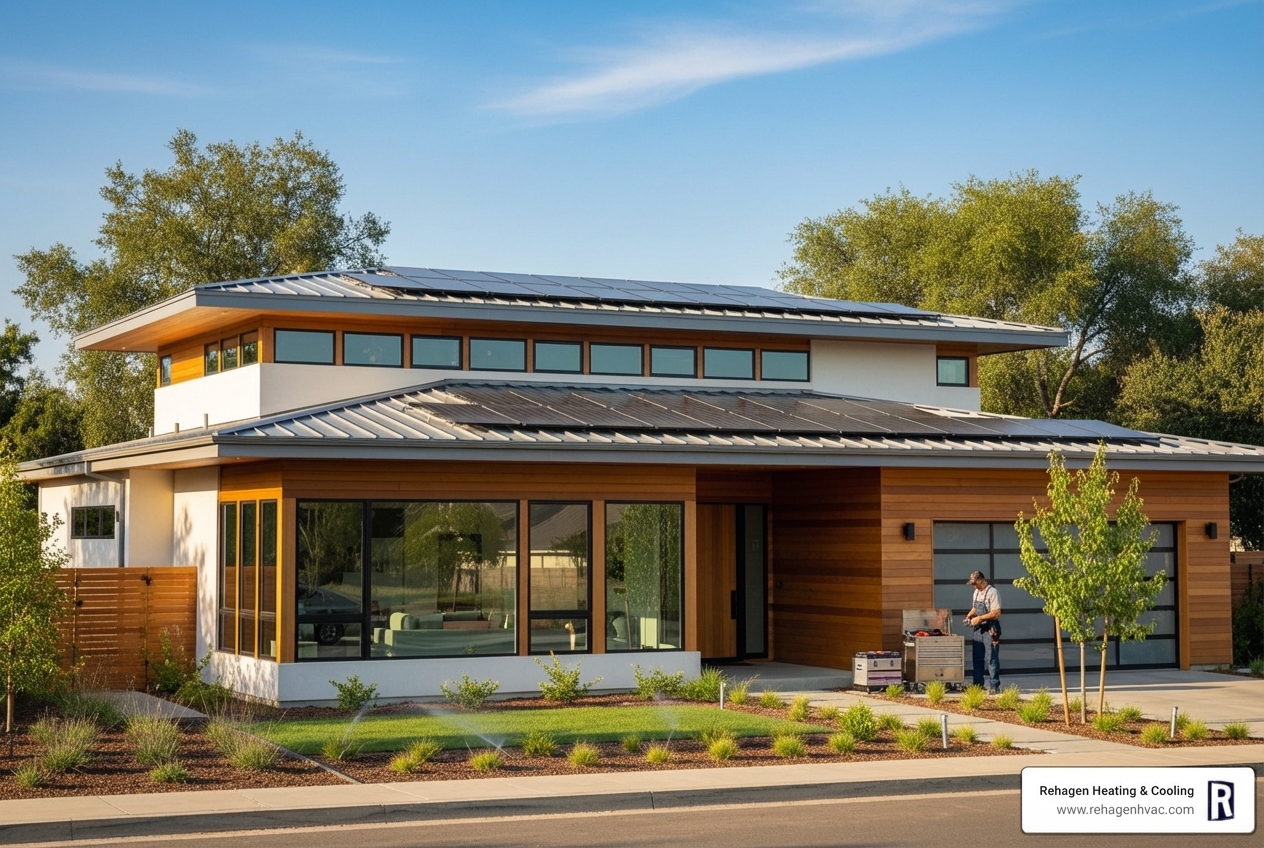
A geothermal solar hybrid system combines two powerful renewable energy sources to heat, cool, and power your home more efficiently than either technology can achieve alone. If you're a Central Missouri homeowner facing high energy bills or an aging HVAC system, this combination might be the upgrade you've been looking for. Solar panels generate electricity from sunlight while geothermal heat pumps tap into the earth's stable underground temperature. Together, they create a reliable, year-round comfort system that reduces your dependence on the grid and fossil fuels.
Key components of a geothermal solar hybrid system:
- Geothermal heat pump - Uses underground loops to exchange heat with the earth for heating and cooling
- Solar photovoltaic (PV) panels - Convert sunlight into electricity to power the heat pump and your home
- Ground loop system - Buried pipes that circulate fluid to transfer heat between your home and the earth
- Optional thermal storage - Stores excess solar heat in the ground for later use
- Battery backup (optional) - Stores solar electricity for nighttime or cloudy days
This guide explains how these systems work together, what benefits they offer, and whether one might be right for your Central Missouri property. You'll learn about real-world applications, challenges to consider, and what the future holds for this innovative technology. Whether you're building new or upgrading an existing system, understanding how geothermal and solar complement each other can help you make a smarter energy decision for your home.
The Power Duo: How Geothermal and Solar Energy Work Together
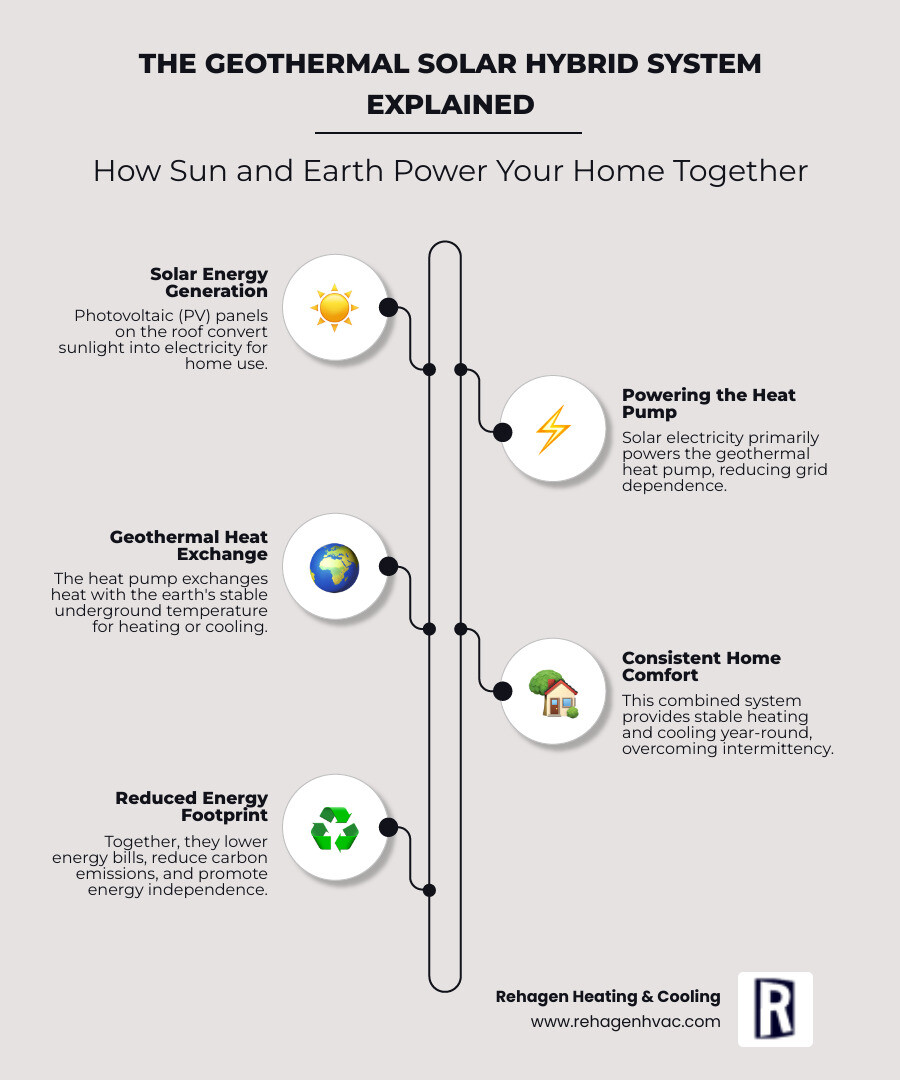
Individually, geothermal and solar energy are remarkable renewable resources. But when they join forces in a geothermal solar hybrid system, they create a synergy that is truly greater than the sum of its parts. This combination offers a robust solution for homeowners in Central Missouri seeking consistent comfort, lower energy bills, and a reduced environmental footprint. To understand this powerful partnership, let's first look at the fundamentals of each technology and then explore how they complement each other. To explore more about how geothermal systems can benefit your home, visit our page on Geothermal Energy Systems Columbia.
The Fundamentals of Geothermal Energy
Geothermal energy is a constant, reliable source of heating and cooling that taps into the stable temperatures beneath the Earth's surface. Just a few feet underground, the earth maintains a consistent temperature, typically between 45 and 75 degrees Fahrenheit, regardless of the scorching summer heat or the biting winter cold above ground.
A geothermal system uses this natural phenomenon through a ground source heat pump and a network of underground pipes, known as a ground loop. During winter, the heat pump extracts heat from the relatively warmer earth and transfers it into your home. In summer, it reverses the process, pulling heat from your home and releasing it into the cooler ground. This continuous heat exchange process makes geothermal energy a remarkably efficient and stable form of baseload energy, meaning it provides consistent output regardless of external weather conditions. This inherent stability is a key reason why many homeowners find geothermal heating ideal. Learn more about why this technology is so effective on our page: Why Geothermal Heating Is Ideal.
The Basics of Solar Energy
Solar energy, on the other hand, captures the abundant power of the sun. The most common way this is done is through photovoltaic (PV) panels, which convert sunlight directly into electricity. These panels are typically installed on rooftops or in open areas, where they can bask in direct sunlight.
Solar energy is clean, renewable, and incredibly powerful during the day, especially on bright, sunny days that Central Missouri homeowners often enjoy. However, its primary limitation is its intermittency: it only generates electricity when the sun is shining. At night, or on heavily overcast days, solar PV production drops significantly or ceases entirely. While solar thermal collectors can also capture the sun's heat for water heating or space heating, they too are dependent on sunlight availability.
The Synergy: Why Combine Geothermal and Solar?
This is where the magic of the geothermal solar hybrid system comes into play. Each energy source's strength covers the other's weakness, creating a resilient and highly efficient system. Think of them as the ultimate tag team for your home's energy needs!
Here’s how they work together:
- Solar powers the heat pump: Our research shows that solar panels can generate electricity to power a geothermal heat pump, making the entire system even more efficient. This means your geothermal system, which is already incredibly efficient, can run on clean, self-generated electricity, leading to significant long-term savings on energy bills.
- Geothermal provides constant heating/cooling: While solar handles your daytime electricity needs, geothermal provides consistent heating and cooling day and night, regardless of weather or sunlight. This addresses solar's intermittency issue head-on.
- Seasonal efficiency balance: It's a fascinating dance of efficiencies. Geothermal systems tend to be more efficient during cooler atmospheric temperatures, as the temperature difference between the ground and the air is less extreme. Conversely, solar PV is most efficient during hot, sunny weather. By combining the two, we mitigate potential output decline caused by changing weather patterns. Your solar panels might work overtime on a hot, sunny day, while your geothermal system quietly maintains comfort. When the cold weather rolls in, the geothermal system continues its steady work, potentially powered by any available solar generation or stored energy.
This complementary relationship ensures a more consistent and reliable energy supply for your home. It’s a smart way to ensure comfort year-round, which is particularly beneficial in areas like Ashland, MO, where we experience a wide range of seasonal temperatures. Explore more about geothermal cooling on our dedicated page: Geothermal Cooling Service Ashland.
Configurations and Benefits of a Geothermal Solar Hybrid System
The beauty of a geothermal solar hybrid system lies not only in its inherent synergy but also in the various ways these two powerful technologies can be integrated to maximize efficiency and benefits. These system models offer increased efficiency, leading to long-term savings and a substantial positive environmental impact. If you're considering enhancing your home's heating system, delving into these hybrid options might be your next step. Learn more about improving your heating on our page: Upgrading to Geothermal Heating System.
Primary Benefits of Combining Geothermal and Solar
When you combine geothermal and solar energy, you're not just getting two renewable sources; you're creating a powerhouse of advantages for your home:
- Improved Reliability and 24/7 Power: One of the standout benefits is the creation of a consistent energy supply. Solar provides power during the day, while geothermal offers a steady, baseload source of heating and cooling around the clock. This means you have reliable energy, day or night, sunny or cloudy, significantly enhancing your home's energy independence.
- Reduced Grid Reliance and Energy Independence: By generating a substantial portion, if not all, of your energy needs on-site, you become less dependent on the traditional power grid. This boosts your energy independence, protecting you from fluctuating utility rates and potential grid outages.
- Significant Carbon Footprint Reduction: This combination delivers a "double punch" to carbon emissions. By leveraging two distinct renewable sources, we significantly cut down on the reliance on fossil fuels, leading to a much smaller carbon footprint for your household. Our research indicates that combining these two can drastically reduce carbon emissions. For instance, one community project saw CO2 emissions fall by an impressive 98%.
- Lower Energy Bills: While the initial investment might be on your mind, the long-term financial benefits are substantial. With solar panels generating electricity to power your geothermal heat pump and meet other household demands, and geothermal providing highly efficient heating and cooling, your energy bills can see dramatic reductions over time. Many homeowners find that these systems provide excellent returns on investment through these savings. To understand how to maximize these savings, check out our guide: Maximize Savings on a Geothermal Upgrade.
Common System Configurations
A geothermal solar hybrid system can be configured in several ingenious ways, each designed to optimize energy production and usage:
- Solar PV Powering a Geothermal Heat Pump: This is perhaps the most straightforward and common residential configuration. Standard solar photovoltaic (PV) panels generate electricity, and this electricity is used to power your geothermal heat pump. This simple setup allows your geothermal system to run on clean, self-generated power, reducing operational costs and your reliance on grid electricity.
- Solar Thermal-Assisted Systems (PVT): This is a more advanced approach that uses Photovoltaic Thermal (PVT) panels. Unlike standard PV panels that only produce electricity, PVT panels generate both electricity and heat. When paired with a ground-source heat pump, these panels can open up up to six times more energy per square meter compared to standard PV. How? The heat collected by the PVT panels can be directly transferred to the fluid circulating in your geothermal ground loop.
- Recharging the Ground Loop (Underground Thermal Energy Storage - UTES): The heat from PVT panels, especially during the warmer months, can be used to "recharge" the ground loop. This means we're depositing solar heat into the earth, which slightly raises the ground temperature around the loops. When winter arrives, the geothermal heat pump then extracts heat from this "pre-warmed" ground, significantly boosting its efficiency. This concept is often referred to as Seasonal Thermal Energy Storage (STES) or Underground Thermal Energy Storage (UTES), where excess solar heat collected in summer is stored in the ground to be used for heating in winter. This clever strategy can even cool PV panels with the thermal loop, which in turn can increase electricity generation by up to 10% from the panels themselves! For more on efficient heating, read about the Advantages of Geothermal Radiant Floor Heating.
Hybrid vs. Standalone Systems
Let's put it simply: a geothermal solar hybrid system offers a compelling middle ground, often outperforming standalone geothermal or solar installations by addressing their individual weaknesses.
| Feature | Standalone Solar (PV) | Standalone Geothermal | Geothermal Solar Hybrid System |
|---|---|---|---|
| Efficiency | High during sunny periods, zero at night | High, consistent year-round | Very High, optimized for all conditions |
| Reliability | Intermittent (weather-dependent) | Consistent, baseload energy | Highly reliable, 24/7 power, mitigates intermittency |
| Environmental Impact | Very low carbon emissions (during operation) | Very low carbon emissions | Extremely low carbon emissions, "double punch" to fossil fuels |
| Energy Independence | High during day, dependent on grid/storage at night | High, consistent | Highest, minimal reliance on external grid |
| Space Utilization | Requires significant roof/land area for panels | Requires land for ground loops, smaller indoor footprint | Optimized use of space, PVT panels can maximize energy per m² |
| Cost of Electricity (LCOE) | Potentially lower without storage, higher with batteries | Stable, competitive | Lower than PV + batteries with thermal storage, very competitive overall |
As you can see, standalone solar is excellent for daytime electricity but struggles with intermittency. Standalone geothermal provides consistent heating and cooling but still requires electricity to operate its heat pump. The hybrid system combines their strengths, providing a highly efficient, reliable, and environmentally friendly solution.
Our research indicates that the hybrid plant with thermal storage can achieve lower Levelized Costs of Electricity (LCOE) than PV systems paired with battery energy storage (PV+BES), primarily because thermal storage is significantly less expensive than batteries. For example, a hybrid plant with a certain solar capacity and 3 hours of thermal storage had an LCOE of $0.081/kWh, while a comparable PV field with 3 hours of Li-ion battery storage was $0.112/kWh. This shows the economic advantage of thermal storage in hybrid systems. Moreover, PVT panels, when integrated with a ground-source heat pump, can open up up to 6 times more energy per square meter compared to standard PV, demonstrating superior performance and land utilization.
Applications, Challenges, and Future Outlook
The concept of a geothermal solar hybrid system is gaining traction, moving from theoretical discussions to tangible, real-world applications. However, like any innovative technology, it comes with its own set of challenges. Understanding both the current applications and the problems ahead helps us appreciate the bright future this sustainable energy solution promises. For businesses, these systems offer significant advantages. Learn more about how they can benefit commercial properties on our page: Commercial Geothermal Heating Solutions.
Real-World Applications
The versatility and efficiency of geothermal solar hybrid systems make them suitable for a variety of settings:
- Residential Homes: Imagine a home powered by the sun during the day, with excess solar energy charging batteries or heating the ground loop. At night, the geothermal system takes over, providing consistent heating and cooling, drawing from the stable earth temperatures. Solar panels can power lights, appliances, and even electric vehicle charging, while the geothermal heat pump efficiently manages indoor climate. This creates a truly self-sufficient and comfortable living environment. For new constructions, integrating these systems from the start can be incredibly efficient. Visit our page: Ground Source Heat Pumps New Constructions.
- Commercial and Industrial Buildings: Larger facilities can reap immense benefits. A factory, for instance, can use solar panels for its electricity needs during operational hours, while geothermal energy provides the necessary heating and cooling for climate control, year-round. This reduces operational costs and improves the building's sustainability profile.
- Community Energy Projects: These systems can scale up to serve entire communities. Picture community projects providing reliable, affordable, and clean energy to dozens or even hundreds of households through combined geothermal and solar systems. A notable example is the Heinöhem community in Sweden. They upgraded their ground source heating system with PVT panels, providing 30,000 kWh of electricity and 160,000 kWh of heat per year. This resulted in an average of 2.8 °C higher brine temperature for their heat pumps and a staggering 98% reduction in CO2 emissions (from 490 tons/year to 8.8 tons/year), improving their energy rating from class G to C and covering 80% of their total energy needs. This demonstrates the profound impact hybrid systems can have at a larger scale.
Challenges and Potential Solutions
While the benefits are clear, implementing a geothermal solar hybrid system does come with certain considerations:
- High Initial Investment: Installing both a geothermal system and a solar array represents a significant upfront cost.
- Solution: We strongly recommend exploring government incentives, tax credits, and financing options available to homeowners in Central Missouri. These programs can significantly offset the initial investment, making these advanced systems more accessible.
- Space Requirements: Geothermal systems require space for underground loops, and solar panels need adequate roof or land area for optimal sunlight exposure.
- Solution: Careful site assessments are crucial. Our experienced professionals can help you determine the feasibility and optimal design for your property, considering available space. For some properties, vertical geothermal loops can minimize the surface footprint. Advanced PVT panels also maximize energy capture from a smaller area.
- Geographical Viability: While Central Missouri is generally well-suited for geothermal systems due to favorable ground conditions, the overall viability depends on specific local geology and solar irradiance.
- Solution: A professional site evaluation by experts like us will confirm your property's suitability for both geothermal drilling and solar panel installation, ensuring the system will perform optimally for your specific conditions.
- Need for Technical Expertise: Designing and installing such integrated systems requires specialized knowledge in both geothermal and solar technologies.
- Solution: This is where choosing the right partner is paramount. We pride ourselves on having NATE-certified professionals with over 40 years of experience in HVAC and geothermal. We understand the intricacies of integrating these systems for seamless performance and reliable comfort. For more insights into how these synergies can be explored, you can refer to research like "Better Together: New Synergies and Opportunities From Hybrid Geothermal Projects" from the Geothermal Library.
The Future of the geothermal solar hybrid system
The future of the geothermal solar hybrid system is incredibly promising, driven by ongoing technological advancements and a growing global commitment to sustainable energy. We are on the cusp of an energy revolution, and hybrid systems are ready to play a central role.
- Technological Advancements: Researchers are continually improving both solar panel efficiency and geothermal drilling techniques. We're seeing the emergence of smarter PVT panels, capable of even greater energy capture. Artificial Intelligence (AI) and Machine Learning (ML) are being leveraged to optimize system design and operation. AI/ML can improve both planning (multi-objective optimization, surrogate modeling) and real-time operation (forecasting, model predictive control), leading to improved efficiency, stability, and cost-effectiveness. This enables truly intelligent operational management of these complex systems.
- Increased Adoption: As the technology matures and costs become more competitive, we anticipate increased adoption of these hybrid solutions in residential, commercial, and community settings across Central Missouri and beyond. The economic and environmental benefits are simply too compelling to ignore.
- Contribution to Grid Stability and Energy Independence: By providing a consistent, dispatchable source of renewable energy, geothermal solar hybrid systems contribute significantly to grid stability. They reduce the burden on traditional power plants and help balance the intermittent nature of other renewable sources. For homeowners, this means greater energy independence, reducing reliance on the traditional power grid and creating more resilient energy solutions for the future.
Frequently Asked Questions about Geothermal Solar Hybrid Systems
We understand that adopting innovative energy solutions like a geothermal solar hybrid system can bring up many questions. Here are some of the most common ones we hear from homeowners in Central Missouri:
How does a hybrid system work in winter or on cloudy days?
This is precisely where the "hybrid" part shines! On cloudy days or during winter, when solar panel output is lower, the geothermal component of the system steps up. Geothermal energy provides a constant, reliable source of heat from the earth, independent of weather conditions. The thermal mass of the earth acts as a natural battery, storing heat that the geothermal heat pump can access consistently.
If your system includes thermal energy storage (like a PVT system recharging your ground loop in summer), this stored heat further boosts the geothermal system's efficiency in colder months. Any remaining electricity needs can be drawn from the grid, ensuring consistent comfort and power for your home, even when the sun isn't cooperating. This combination effectively addresses the intermittency issues typically associated with standalone solar energy.
Is my property suitable for a geothermal solar hybrid system?
Most properties in Central Missouri are excellent candidates for a geothermal solar hybrid system, especially for the geothermal component. However, suitability depends on a few key factors:
- Property Size: You'll need adequate space for the geothermal ground loops (though vertical loops can minimize the footprint) and sufficient unshaded roof area (or ground space) for solar panels.
- Ground Conditions: Central Missouri's geology is generally favorable for geothermal installations. A professional site assessment will confirm the specific ground conditions for optimal loop design.
- Solar Access (Sunlight): Your property needs good access to sunlight, ideally with minimal shading from trees or other buildings, for efficient solar panel performance.
- Local Climate: Our diverse Central Missouri climate, with hot summers and cold winters, makes the hybrid system particularly effective, as both technologies excel in different seasons.
The best way to determine your property's suitability is through a professional assessment. We offer comprehensive evaluations to design a system that perfectly fits your home and energy needs. For more details on geothermal heating specifically, check out our page: Geothermal Heating Jefferson City MO.
What maintenance is required for these systems?
One of the many appealing aspects of a geothermal solar hybrid system is its relatively low maintenance requirements compared to traditional HVAC systems.
- Geothermal Maintenance: The underground loops of a geothermal system are incredibly durable and require virtually no maintenance once installed. The indoor heat pump unit typically needs routine checks, similar to a conventional furnace or air conditioner, such as filter changes and occasional professional servicing to ensure optimal performance.
- Solar Panel Cleaning: Solar panels generally require minimal maintenance, primarily occasional cleaning to remove dirt, dust, or debris that might accumulate and reduce efficiency. In Central Missouri, rain often takes care of much of this, but a periodic professional cleaning can be beneficial.
- System Monitoring: Modern hybrid systems often come with monitoring capabilities, allowing you to track energy production and consumption. This helps identify any issues early on.
We recommend annual professional servicing for the indoor components of your geothermal system and a periodic check-up for your solar array to ensure everything is running at peak efficiency. Our NATE-certified professionals are experts in maintaining these advanced systems, providing reliable service that extends the lifespan and efficiency of your investment. Learn more about our specialized services: Geothermal Heat Pump Services Westphalia MO.
Conclusion: Using the Power of Sun and Earth
The geothermal solar hybrid system represents a powerful leap forward in home energy solutions. By using the consistent warmth of the Earth and the abundant power of the sun, these systems offer an unparalleled combination of benefits for homeowners in Central Missouri. We've seen how this dynamic duo provides exceptional reliability, significantly reduces your environmental impact, and moves you closer to true energy independence.
This perfect partnership ensures that your home remains comfortable year-round, efficiently heated and cooled by the earth, and powered by the sun. It's a smart, sustainable investment in your property and the planet.
At Rehagen Heating & Cooling, we've been Central Missouri's HVAC and geothermal experts for over 40 years. Our NATE-certified professionals are dedicated to providing honest service, precision workmanship, and reliable comfort, backed by strong warranties. We are the #1 geothermal supplier in the region because we believe in delivering the best.
Ready to explore how a geothermal solar hybrid system can transform your home's energy future? We're here to guide you every step of the way. Learn more about our Geothermal Heat Pumps and find how we can help you harness the power of the sun and earth for ultimate comfort and savings.
Related articles

request service
